Carriage by Road Act Registration in India: Process, Documents, Cost and Timeline
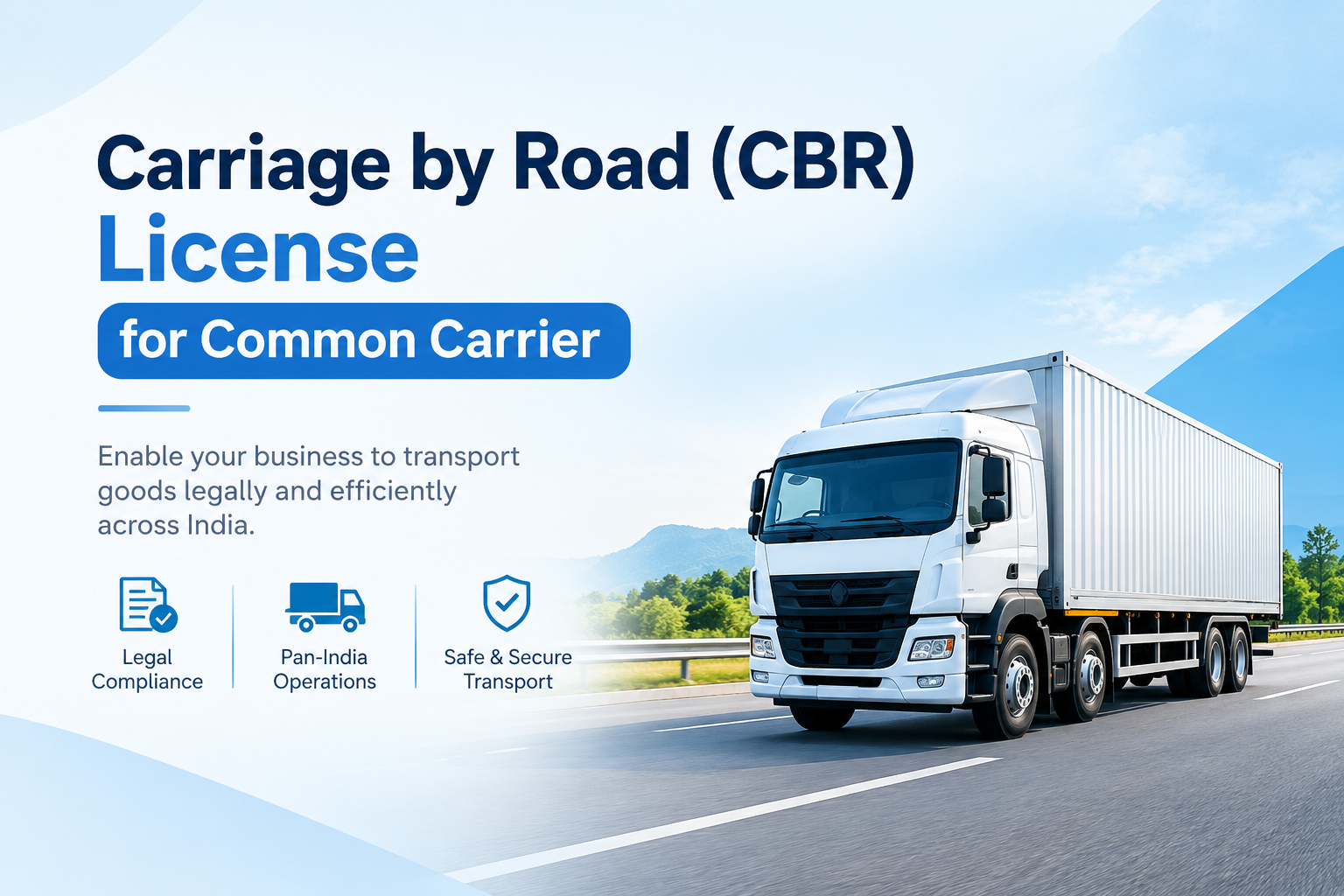
If you run a logistics, courier, freight or transport business in India, you may have heard that you need a registration under the Carriage by Road Act, 2007. Many businesses discover this late, often when a large customer asks for proof of registration. This guide explains the registration in simple terms: who needs it, how to apply, which documents to keep ready, what it costs and how long it takes.
What is the Carriage by Road Act, 2007?
The Carriage by Road Act, 2007 is a central law that regulates common carriers who carry goods by road. It was published on 29 September 2007 and works together with the Carriage by Road Rules, 2011. The Act covers three main things:
- Registration: a common carrier cannot do business without a certificate of registration.
- Documentation: each consignment is covered by a Goods Forwarding Note (GFN).
- Liability: the carrier's responsibility for loss, damage or delay is defined and limited.
People often call this registration a "licence", "common carrier licence" or "carriage by road licence". The Act itself uses the term certificate of registration.
Who needs a Carriage by Road Act registration?
Anyone who is engaged, or intends to engage, in the business of a common carrier must apply. A common carrier is a person in the business of collecting, storing, forwarding or distributing goods to be carried by goods carriages under a goods forwarding note, for a fee. The definition also includes an agent or broker carrying on the business of a common carrier.
In practice, this can apply to:
- Logistics and supply chain companies, including multinationals
- Transport and freight forwarding companies
- Courier and express cargo companies
- E-commerce and warehouse operators that book goods for carriage
- Transport brokers and aggregators
Whether your business falls within the definition depends on how you operate. Please take advice before assuming you are exempt.
Which authority grants the registration?
The registering authority is the State Transport Authority or Regional Transport Authority set up under section 68 of the Motor Vehicles Act, 1988.
Carriage by Road Act registration process: step by step
The exact steps and forms can differ from state to state, but the process generally looks like this.
- Check eligibility and structure. Confirm that you will act as a common carrier and decide which entity will hold the registration. The Rules set conditions for grant, which the authority checks before granting registration.
- Prepare your documents. Gather company, address, vehicle and agreement records (see the list below).
- Identify the correct registering authority. Find the STA or RTA that has jurisdiction over your main office.
- File the application. Submit the prescribed application with documents and the prescribed fee.
- Respond to queries. The authority may ask for clarifications or additional papers. Quick, complete answers save time.
- Grant of certificate. The authority grants the certificate of registration if the conditions are met. If it refuses, it must give written reasons.
- Start complying. Put the compliance system in place straight away (see below).
Documents required
The authority's checklist varies, so confirm it before you file. Documents commonly needed include:
- Certificate of incorporation, MOA and AOA (or partnership deed or proprietorship proof)
- PAN and GST registration of the applicant
- CA Certificate / Balance Sheet
- Address proof and ownership or rental proof of the main office
- Details of branch offices, if any
- Details of vehicles owned or hired, with registration certificates, permits and fitness certificates
- Agreements with fleet owners or transporters
- Sample Goods Forwarding Note and goods receipt formats
- Authorisation or board resolution for the signatory
- Identity and address proof of directors or partners
- Prescribed affidavit or declarations, if required by the Rules
Cost of Carriage by Road Act registration
There are two parts to the cost:
- Government fee: the fee is set under the Carriage by Road Rules, 2011 is Rupees Five Thousands (Rs. 5000) and paid to the registering authority.
- Professional fee: this depends on the size of the business, the number of branches and vehicles, the state concerned and how much compliance work is needed.
Other costs to plan for include notarisation, stamp duty on agreements and the time your own team spends gathering documents.
Timeline: how long does it take?
The Act and Rules require the registering authority to decide within a fixed period after receiving a complete application. In practice, the total time depends on how complete your documents are, the state authority and how many queries arise. Typical total time from preparation to certificate is about 60 days. Starting early, and keeping your papers consistent across entities, is the best way to avoid delay.
Validity and renewal
The certificate of registration is valid for a fixed period under the Act Five (5) Yearsand must be renewed before it expires.
What happens if you operate without registration?
The Act says no person may engage in the business of a common carrier without a certificate of registration. Operating without one exposes the business to legal action, and large customers often insist on proof of registration before contracting. [Add the specific penalty provision after checking the Act.]
How LegalTech India can help
We have recently obtained a Carriage by Road Act registration for a multinational logistics client, a niche area where few advisers work. Our team can:
- Assess whether your business needs registration
- Prepare and file the application with the registering authority
- Prepare GFN, goods receipt and customer contract terms aligned to the Act and Rules
- Train your teams and set up a compliance calendar
- Handle renewals, changes and updates to the law
Contact LegalTech India:
Mob: +91-8369725134
Email : info@legaltechindia.in